
Vice President J D Vance has said that the United States hopes that India will respond to the Pahalgam terrorist attack in a way that does not lead to a 'broader regional conflict' and expects Pakistan to 'cooperate' with New Delhi to 'hunt down' militants sometimes operating from their soil.
In the wake of the recent hostilities, both sides have moved from weapons to words, with India dispatching several delegations to visit more than 30 capitals across the world. A similar effort by Pakistan is set to start on Jun 2.

'It is typical of China's strategic deception of making virtue out of necessity,' observes Rup Narayan Das.

Top military officials from India and Pakistan highlighted their views at the Shangri-La Dialogue in Singapore, billed as Asia's premier defence forum, amid heightened tensions between the two sides following last month's military confrontation.

Trump couldn't care less anymore about the Israeli demand for Iran's 'de-nuclearisation' and 'de-militarisation.' Trump pins hopes on a grand bargain with Iran as a partner in America First, argues Ambassador M K Bhadrakumar.
'The devastating Indian Air Force strikes on the night of May 9-10 exposed Pakistan's vulnerabilities.' 'If these had continued, it would have further degraded Pakistan's ability to continue with air operations.'
Pakistan's decision to talk to India on May 10 stemmed from realisation that it will suffer more if its operation continues, Gen Chauhan said.

External Affairs Minister S Jaishankar addresses Parliament on Operation Sindoor, denying any US trade linkage and highlighting Pakistan's request for a ceasefire through the DGMO channel.
'Unfortunately, India and Pakistan could learn a 'lesson' from this conflict that will make them more likely to use these weapons against each other in the future.' 'Rounds of missile and drone attacks could be more routine features of their hostility, just like artillery fire has become a familiar fact of life along the Line of Control.'

India on Thursday said the issue of trade did not come up at all in talks between Indian and American leaders during its military clashes with Pakistan, virtually rejecting Washington's repeated claims that its offer of trade stopped the confrontation.

'There's a lot of sense in what Prime Minister Modi did, but the Indian government has to be really prepared for a really sharp escalation spiral.'
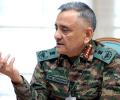
Chief of Defence Staff General Anil Chauhan on Saturday said India's Operation Sindoor has drawn a 'new red line' of intolerance against terror, and expressed hope that the military action has brought 'some lessons for our adversary also'.

John Spencer, the chair of Urban Warfare Studies at US-based think-tank Modern War Institute, said India showcased its ability to strike any target in Pakistan "at will" and drew and enforced a "new red line" for cross-border terrorism under the operation that was launched early on May 7.
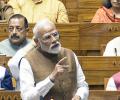
What was the aim of Operation Sindoor? Why was the operation halted so soon? asks Lieutenant General Prakash Katoch (retd).

The United States said it encourages 'direct communication' between India and Pakistan and commends Prime Minister Narendra Modi and Pakistan Prime Minister Shehbaz Sharif for choosing the path of peace.
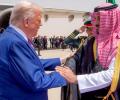
'I said, fellas, come on, let's make a deal, let's do some trading, let's not trade nuclear missiles, let's trade the things that you make so beautifully, and they both have very powerful leaders, very strong leaders, smart leaders, and it all stopped.'

We have nothing to gain by raising our concerns internationally as our narrative has got entangled with several controversial concepts in the United Nations, asserts Ambassador T N Sreenivasan.

One Iranian woman, who is the wife of an Indian national has also been evacuated, he added.

A senior leader of the ruling Pakistan Muslim League-Nawaz (PML-N) on Wednesday claimed that the military operation against India was designed under the supervision of the party president Nawaz Sharif.

The BRICS nations condemned the Pahalgam terror attack, advocated for a zero-tolerance approach to terrorism, and criticized rising tariffs during their summit in Rio de Janeiro. They also addressed global challenges and called for reforms in international institutions.

Jaishankar said the world has experienced its consequences in terms of higher costs and shortages of foodgrains and fertilizers and fuel.
'Trump's sons, and the son of Trump's Mideast envoy Steven Witkoff, are in the crypto business and recently signed deals with Pakistan's crypto council.' 'It may not be coincidental that not long before the Trump-Munir meeting, the head of Pakistan's crypto council met with Trump's White House crypto policy czar.'
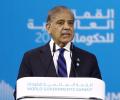
Sharif said that the US president had shown beyond any doubt that "he is a man for peace... and beneficial business deals".

'They thought nobody would hit Bahawalpur and Muridke because they have nuclear weapons.' 'They used to think India cannot touch our military targets because we are a nuclear weapons country.' 'After Operation Sindoor we have called their bluff.'

'The condition was getting worse here every minute'

India on Tuesday evacuated over 1,100 citizens from Iran and Israel amid ongoing tensions between the two countries, taking the number of evacuees under Operation Sindhu to 3,170.

'We are too important to want to be paired with Pakistan but too intensely connected to it to successfully detach ourselves,' asserts Aakar Patel.

India has accused Pakistan of violating the spirit of the Indus Waters Treaty by engaging in acts of terrorism and refusing to modify the treaty. India's Permanent Representative to the UN, Ambassador Parvathaneni Harish, addressed the UN Security Council, highlighting Pakistan's disinformation regarding the treaty and its continued support for cross-border terrorism. He stated that India has always acted responsibly as an upper riparian state and that Pakistan's actions have jeopardized civilian lives, religious harmony, and economic prosperity. India has suspended the treaty until Pakistan ends its support for terrorism.

External Affairs Minister S Jaishankar has said the recent confrontation between India and Pakistan was not just a mere conflict between two neighbours, but it was about combating terrorism, which will eventually come back to haunt the West.
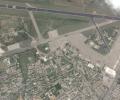
India's strikes on Pakistan damaged runways and structures across at least six airfields, according to a visual analysis by The Washington Post, which experts said were the most significant attacks of their kind in decades of simmering conflict between the two nations.
S&P Global Ratings on Tuesday upped India's GDP growth forecast for the current fiscal to 6.5 per cent, citing lower crude prices, monetary easing and normal monsoon, and said the ongoing geopolitical tensions are unlikely to put a "significant pressure" on the rupee or inflation.
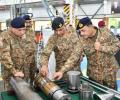
'Pakistan's army has got a streak of democracy. It is more democratic than the country.'

'There is no independently verified imagery or battlefield evidence to support Pakistan's claim.'

The formulations in the declaration in reference to terrorism is going to be to our "satisfaction", Dammu Ravi, secretary (economic relations) in the external affairs ministry said on Monday.
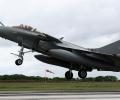
The western media is going all out to prove that India suffered a major setback in Operation Sindoor and how China helped shoot down Indian fighter jets. One of the articles published in British newspaper Telegraph stated Operation Sindoor shattered the myth of India's air dominance over Pakistan. "The Pakistani Air Force, aided by Chinese targeting satellites and AWACS executed a sensor-fusion kill. The Rafales never got a lock, never even saw their adversary. When the missiles hit, it was already over," wrote the British Newspaper, The Telegraph.

Referring to Pakistan's NSG membership application, the CRS said according to US law, the Obama Administration could apparently back Islamabad's NSG membership without Congressional approval.
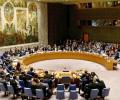
The United Nations Security Council held closed-door consultations on rising tensions between India and Pakistan, with envoys calling for restraint and dialogue. The consultations, requested by Pakistan, lasted for about an hour and a half. UN Secretary-General Antonio Guterres expressed concern over the tensions, urging both countries to avoid a military confrontation. India's former Permanent Representative to the UN, Syed Akbaruddin, said that no consequential outcome could be expected from the discussion.

'The lesson Beijing would have learned is that there is, cost-benefit wise, no better option than to keep the Pakistan military supplied with its most advanced armaments, certain that in hostilities with India these would be used for maximum effect.'

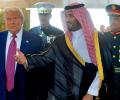
Acutely conscious that he's left with less than four years to create his legacy, Trump is undoubtedly a man in a hurry, observes Ambassador M K Bhadrakumar.
 © 2026 Rediff.com - Advertise with us - Disclaimer - Privacy Policy - Sitemap - Feedback - About us - Terms of use - Grievances